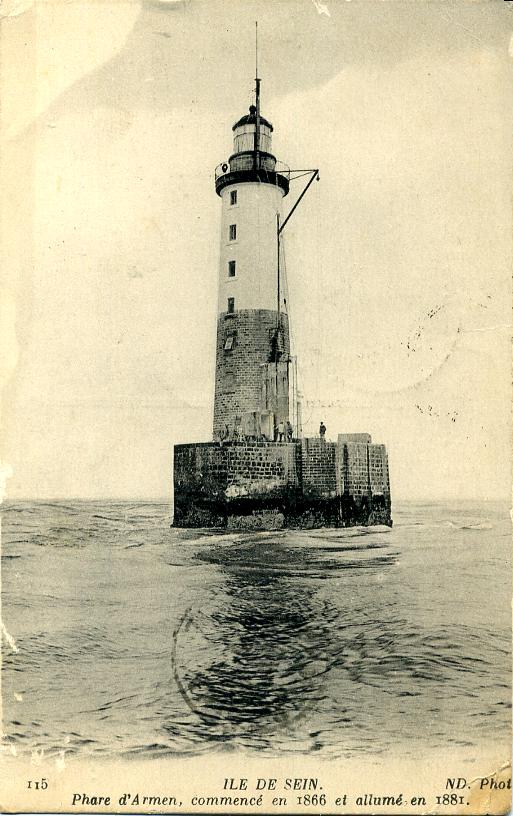
Ar-Men.
Amen to that.
We made an attempt, a considerable attempt, to tick Ar-Men off, the most isolated Fr. light south of Brittany, but the Gods did not smile on us that day.
We shipped out unto the Île de Sein to get the nearest view from land obtainable, as I have described in posting number 42 of the same name. But we were denied by persistent sea mists.
I must make reference to this lighthouse notwithstanding, given the status it holds in the French pharologist's mind, given its position as arguably the most famous lighthouse of France when it comes to rough seas and foaming spume. I have already suggested in the aforementioned post 42, Île de Sein, that you take a look at some of the dramatic images that have been made of Ar-Men, almost invariably obtained from aerial platforms, as there is no way one can be close to the phare on a boat in rough weather unless one is intent on wrecking for the insurance claim. As for land adjacent… there isn't any, at least not close enough to provide anything close up and personal. A few rocks maybe, to cling to, when the pedalo goes down… So, therefore, that means that this is also the most famous French lighthouse that has been seen by hardly anyone without wings.

Huelse has a historic postcard view taken from the sea surface on an atypically calm day.
The name Ar-Men means 'great rock' in Breton. After many years of planning and discussion, efforts to build a lighthouse on this westernmost rock of the Chaussée de Sein began in 1861. So great were the difficulties that it was 1867 before the first stones were actually laid. What were they up to for the first five years? The masons often had only minutes to work and only could really get to it at the lowest tides and in the calmest seas. Quite how it ever got finished is quite beyond my reckoning. It was twenty years before Ar-Men was first lit followed by another twenty years dedicated to the improving and shoring up of the tower. Keepers staffed the lighthouse in thirty day shifts until it was automated in April 1990. They didn't get out and about much when doing a stint, that's for sure.
Jean Guichard has made famous photos of massive waves sweeping around the tower, and he has a photo of waves breaking over the lighthouse in the great storm of 19 March 2007. JG features Ar-Men in many publications which embrace his photographic prowesss … or his publishers do. Lightphotos.net has a photo showing the surf on an 'average' day.
The Lighthouse Directory, to whom I am indebted for this distillation concerning Ar-Men, also notes that the lighthouse is accessible only by helicopter or by boat in roaring seas. I am afraid I cannot throw any light as to why the seas need to be roaring to allow helicopter or boat access. I would have thought access might more easily be achieved across placid waters comparable with mill ponds– but I realise I have no experience of the Ar-Men environs, so will take it on trust and wait in hope of roaring seas prevailing that may one day afford my acquaintance with this phare mythique . . .
The Lighthouse Directory, to whom I am indebted for this distillation concerning Ar-Men, also notes that the lighthouse is accessible only by helicopter or by boat in roaring seas. I am afraid I cannot throw any light as to why the seas need to be roaring to allow helicopter or boat access. I would have thought access might more easily be achieved across placid waters comparable with mill ponds– but I realise I have no experience of the Ar-Men environs, so will take it on trust and wait in hope of roaring seas prevailing that may one day afford my acquaintance with this phare mythique . . .
I am indebted to Jean Benoît Héron (upper right above) and Stéphane Bossis (lower right above) for their excellent elevation illustrations of Ar-Men which grace this appendix. The aerial view that comes first is a Wikimedia Creative Commons photo by Jocelyn Caron, taken in 2011 from, obvs., a helicopter.
 If you do publish a book on Fr lights, like Philip Plisson & Guillaume Plisson did back at the end of the last century, you can bet your life that if you have taken a half decent portrait of Ar-Men in a gale, your publisher will insist on your effort being the front of house image on the dust jacket: it is de rigeur!
Which is why the Plissons' English language version of Phares Ouest (Lighthouses of the Atlantic) sports the view of Ar-Men that it does. And why Ar-Men was the poster image for the associated exhibition as well. You might think those pictures were taken from a boat; they weren't, although damned close to the brine, notwithstanding. But still snapped from a (Naval) helicopter, at Fr tax payers' expense, no doubt…
Jean Guichard seemingly has the same insistences from his calendar publisher (lots of Ar-Men snaps, s'il vous plaît Monsieur, if you don't mind!)…… merci!

Which is why the Plissons' English language version of Phares Ouest (Lighthouses of the Atlantic) sports the view of Ar-Men that it does. And why Ar-Men was the poster image for the associated exhibition as well. You might think those pictures were taken from a boat; they weren't, although damned close to the brine, notwithstanding. But still snapped from a (Naval) helicopter, at Fr tax payers' expense, no doubt…
Jean Guichard seemingly has the same insistences from his calendar publisher (lots of Ar-Men snaps, s'il vous plaît Monsieur, if you don't mind!)…… merci!