MARSEILLE LACKS A GOOD LIGHTHOUSE. It is a pity really, they have had something like, in the past. Something like La Vieille, out there in the Rade, up on one of those islands instead of that telecommunications mast. With a first order Fresnel flashing out proudly over the approaches to what is after all France's most extensive sea port and the second city of the Republic. Just a thought.
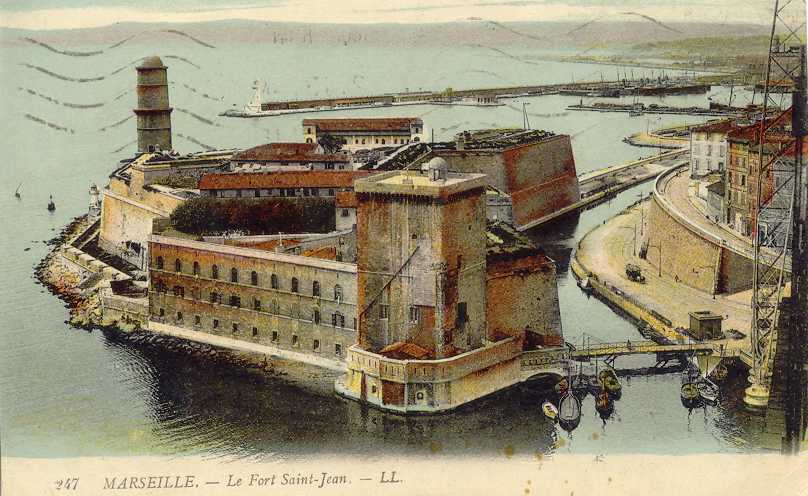
There is plenty of interest on the feu front, notwithstanding. Feu de Sourdaras is a lit cardinal while the Tourelle de Canoubier isn't lit but is the oldest French beacon to be built on an underwater foundation, back in 1833. Cardinals with history, part of the Marseille scene. Sourdaras even had a lantern for a while. Now it gives nine quick flashes of white illumination every nine seconds from a LED lamp affixed to the top of the tower.

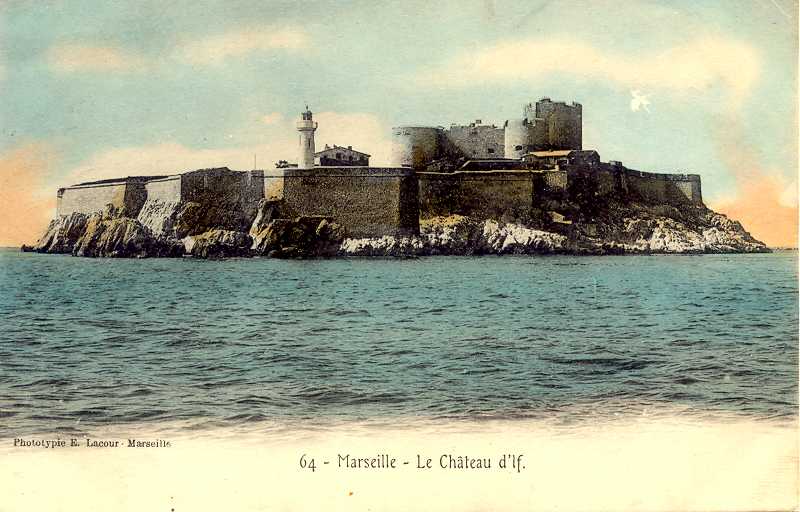
This one was built in 1948 and has a focal plane of twenty-seven metres. There are two white flashes every 6 seconds to make its presence felt at night, from the seventeen metre tall tower. The original lighthouse, only 9 metres high was destroyed in 1944. Huelse provides the scholar with a postcard view of the 1863 tower. Château d'If is a castle built in the 1520s on a small island off Marseille and as you will be aware no doubt, was used for many years as a prison for state undesirables, as well as to give authors of distinction somewhere to site incarceration plots in their latest page-turners. The tower is at the eastern tip of the island, marking the entry to Marseille from the south. We passed close by the point on a boat trip round the bay back in 2015. Island open, lighthouse not so.


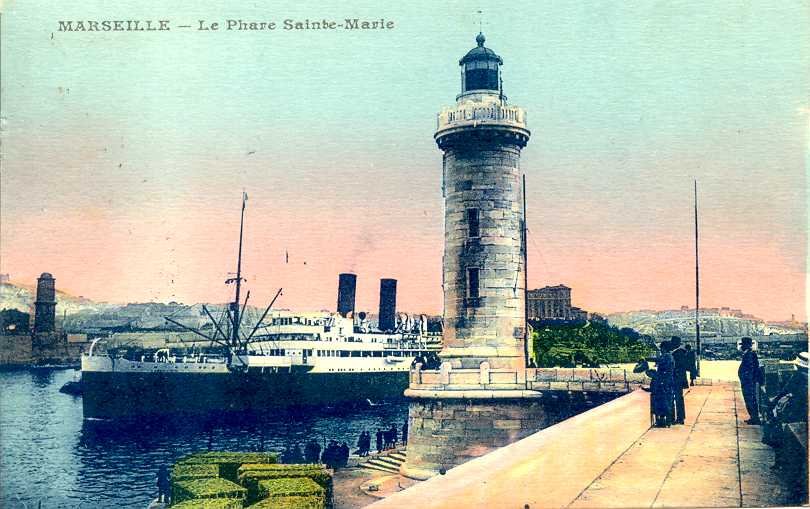
 The current entrance lighthouse, Phare de Sainte-Marie, is also unlit which I think is utterly shameful. If Biarritz can be proud of its fine tower and light it up, why in heaven's name can't Marseille? Sure, the phare is floodlit at night but the light should be coming from the lighthouse lantern first and foremost; what are the authorities thinking of?
Anyway, anyway (sigh) — the lighthouse Sainte Marie was commissioned in 1855. Huelse stocks an historic postcard view. You see, the harbour of Marseille is a series of bassins separated by dykes and quays. This phare is positioned at the south entrance to these bassins on the Digue Sainte-Marie; the entrance is called the Passe de la Joliette and that leads to the southernmost bassin, the Bassin de la Grande Joliette (I trust you are following this). The Phare de Sainte-Marie has been deactivated 'in favour' of the Digue Sainte-Marie light, (a red lamp on three sticks — see my picture herewith left) at the end of the new breakwater extending southwest from the Digue Sainte-Marie. Oh come on, pull the other. My point is: Phare de Sainte-Marie is the best looking tower in town — so get it lit again, for the tourists at least — and for the general beauty of the Marseille seafront. You know it makes sense! Replace and update your harbour lights if you must but don't blind the iconic phare in favour of a tripod, fgs! Let's have both.

There is just one more of these minor lights to pass before you, a stylish adaptation of what is after all another dashed harbour light, but nicely dressed up a mini-phare to give it a bit more personality than a mere lamp up a pole. I refer to Pointe de la Désirade of 1881 (Le Pharo), see below. The focal plane is thirteen metres, dispatching a green flash every four seconds. The structure itself is fifteen metres in height, a cylindrical stone tower with lantern and gallery as you can clearly see. The feu stands just offshore and is connected to land by a footbridge about halfway up the tower. Neat! No need to get the boat out then.
Huelse has an historic postcard view in his possession. The name Pharo does not refer to the lighthouse but to the nearby Palais du Pharo, a palace built by Napoléon III for his wife Eugénie (ever the gentleman) and now part of the university. You'll be amazed to learn that this structure is actually on the Pointe de la Désirade, also called the Pointe du Pharo, on the south side of the harbour entrance.

We were treated in 2015 to a very good sea-front hotel in Marseille and had toothsome victuals, the aforementioned boat ride etc, in celebration of friend Anne's significant birthday. We have been to Marseille before that, twice I think. And liked it. Of course we have barely scratched the surface of the place, we do tend to stick to the sea front, the wonderful docks and all that sort of thing. There are way too many boat parks west of the commercial quays, of course. They merge into a solid mass — wall to wall — yachts, launches gin palaces, dinghies, pedalos etc. Who owns them? What are they for? When if ever do they go anywhere? Did you know that the average vessel moored in these places, blocking the view and the sea from the common man, spends less than two days a year at sea?
Still need to get into the Marseille quayside art gallery and the wondrous confection of a cathedral, etc. Lots to see and do as you'd expect. And pretty warm in due season. Parking is tricky and pricey. A city right on the edge of the Mediterranean; very hilly, amongst dramatic limestone scenery. Très cosmopolitan. You'll note that the ww2 occupiers thought highly of it too last century: those are Todt constructions on the Pointe de la Désirade pictured above. Gun emplacements.
Marseille does have, far out, a fine rock lighthouse, Le Planier. A real phare of distinction. But as it is equidistant with Ciotat I shall feature Le Planier in that post if you don't mind too much. Just to spread them out a bit more, as it were. It is the last light of any real elevation on this coast excepting those stuck up on hill tops. So saveur it when it shows up in the next post…