Beauduc was first lit in 1903 (a day-beacon had been on site since 1865). The shock news is that this lighthouse has just been deactivated (in 2019)! It is 27 metres (89ft) tall and is a round stone tower with lantern and gallery. There is a generous keeper's house close by; well, no one is going to pop down on a bike to light this phare of an evening, it is miles from anywhere! Huelse has a historic postcard view.
Beauduc stands on a sweeping curve overlooking the étang de Sampan at the southern edge of the Camargue. The Pointe de Sablon in fact. It has been replaced with a buoy FGS! I am not sure why but Beauduc is considered to be endangered, maybe because it is being undermined? — it is the sort of fate that can befall lights on sandy spits. The now dark tower is to be found (sayeth The Lighthouse Directory), about sixteen kilometres south-east of Les Saintes-Maries-de-la-Mer and is only accessible by boat or by a long hike along the beach. (I imagine you could do it by helicopter with the necessary permissions, uniforms, and appropriate flying machine —ed) It used to show a red light, two flashes every ten seconds from its black painted lantern with a range of sixteen nautical miles. Surely not something to discontinue?


The second bonus to our long walk to La Gacholle, was another shimmering image to the east-south-east, which, once the banding of black and white was confirmed, could be none other than the almost legendary Faraman lighthouse; also very isolated, the other of those two most remote phares mentioned above, and the second tower of the Camargue I had resigned myself to never seeing. If we had bikes, maybe. But sans velo? No. And the track that passes by Faraman is closed to all motor-vehicles for many miles in any direction. Unless they've changed the rules.
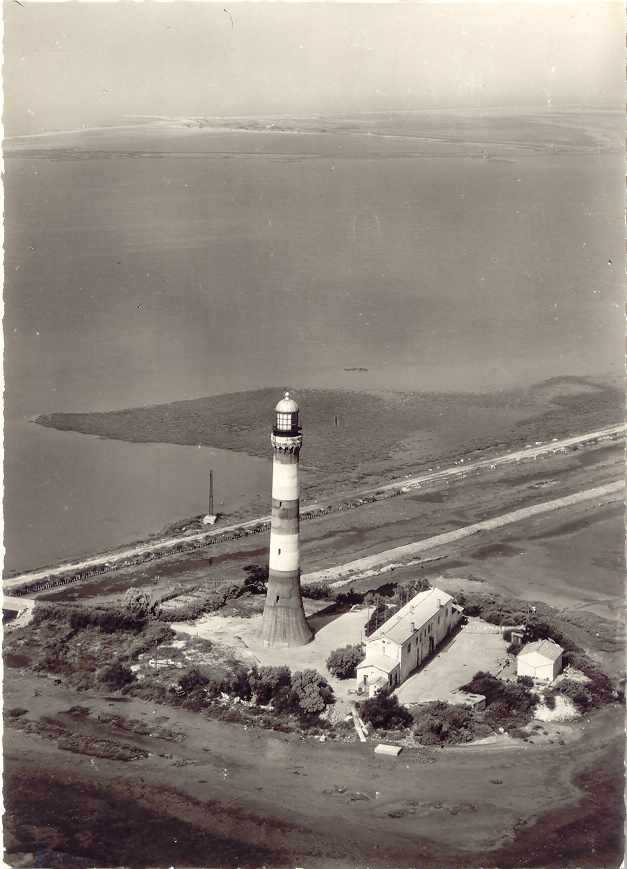
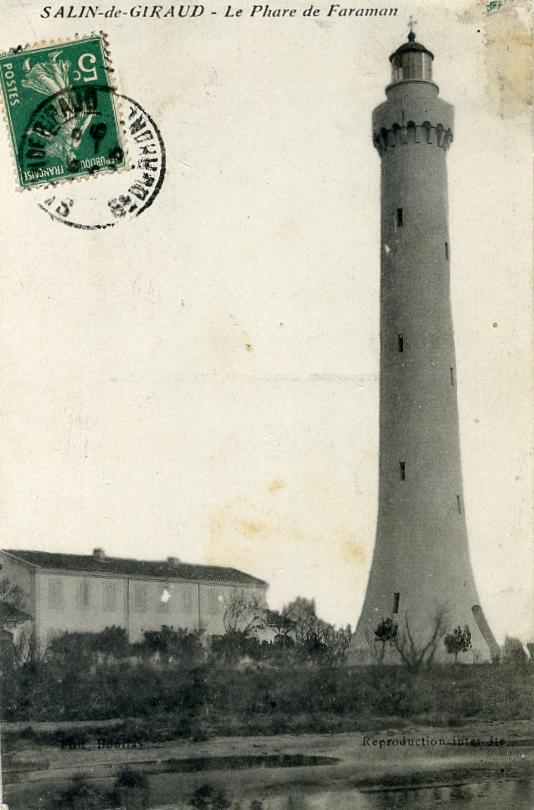
Faraman marks the southernmost extension of the Camargue. It stands about 500 metres from the surf, in an area of large lagoons famous for their huge flocks of flamingos. It was damaged during ww2 but repaired between 1947 and 1950. The present lighthouse was built using much of the stone from the previous 1840 lighthouse. It is situated about twelve kilometres southwest of Salin-de-Giraud. It is accessible by an unpaved (rough) road called the Route du Sémaphore, which crosses the wetlands on a series of dikes and causeways. But not accessible in a motor unless you have a uniform on, and a key to all the gates. Of course, this famous and rather svelte lighthouse carries the Monument Historique distinction with pride. We were most pleased to spot it and snap it, albeit at the maximum telephoto resolution available to us.
Illustrations by JBH, with thanks, pictures by me, your author.
And thanks too, to The Lighthouse Directory for information, and from therein, Huelse for historical imagery.