The Côte d'Azur in fact.
The son-and-heir made a lightning dash to the area, back in his careless youth, but only managed to photograph just one lighthouse on his jolly. He has obviously decided not to follow in his father's footsteps. It is noted. Must speak to my solicitor…… but I am grateful for his single contribution to this page, at least; I might relent viz the inheritance. Friend Anne comes and goes to Nice when not in lockdown, but she also has not fulfilled her Côte d'Azur lighthouse quota pictorially, much to my frustration. I shall press on to the bitter end, notwithstanding. Mme Melling of course was a familiar figure in these parts in another life but that is all she is prepared to divulge to me at this time.
So: the highest lighthouse in France! It is the Phare de la Maure and is in a place called Vallauris which is a suburb or satellite of Cannes, the coastal resort and port it serves.
The Phare de la Maure was commissioned in 1927. It has a focal plane of 167 metres or 548ft. From that height the lighthouse shows a light that has white, red or green aspects to it depending on where you are observing it from, and it occults twice every six seconds. The ranges in nautical miles are: white: sixteen miles; red: twelve miles, green: eleven miles. The tower is nineteen metres tall and is a square stone build, with the expected lantern and gallery. The lighthouse is unpainted white stone; while the lantern is painted black. Huelse has an historic postcard view. The current title-holder replaced a tower at sea level which had to be taken down as it began listing rather alarmingly. Poor foundations I imagine. What to do? Go up the hill! So the highest lighthouse in France is located on the Boulevard des Horizons, high on the hillside in Vallauris, overlooking the Golfe-Juan and about three kilometres east northeast of the Cannes waterfront. It has Monument Historique status.

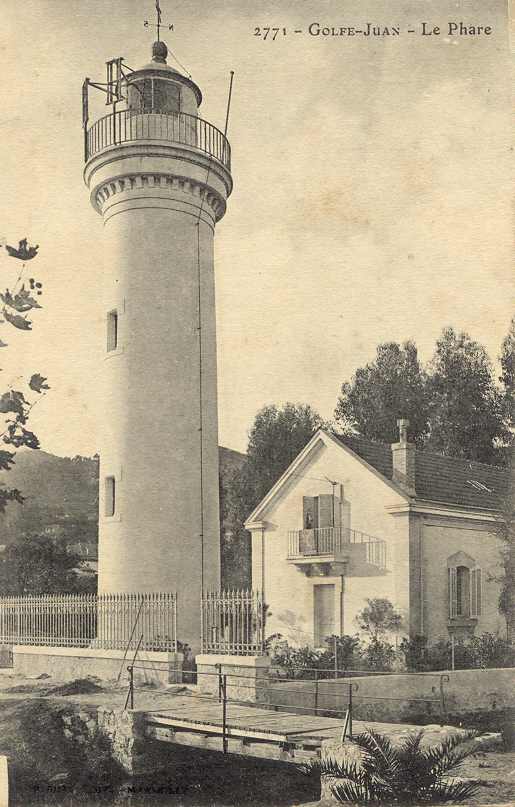
La Garoupe is the landfall light for Antibes, Cannes, and the Côte d'Azur, one of the most powerful lights of the Mediterranean. Huelse runs to an historic postcard view of the original lighthouse, the one blown up by axis forces in 1944. The phare is surrounded by the Bois de la Garoupe, a forest preserve managed by the city of Antibes, and overlooks the Baie des Anges. Top flight!
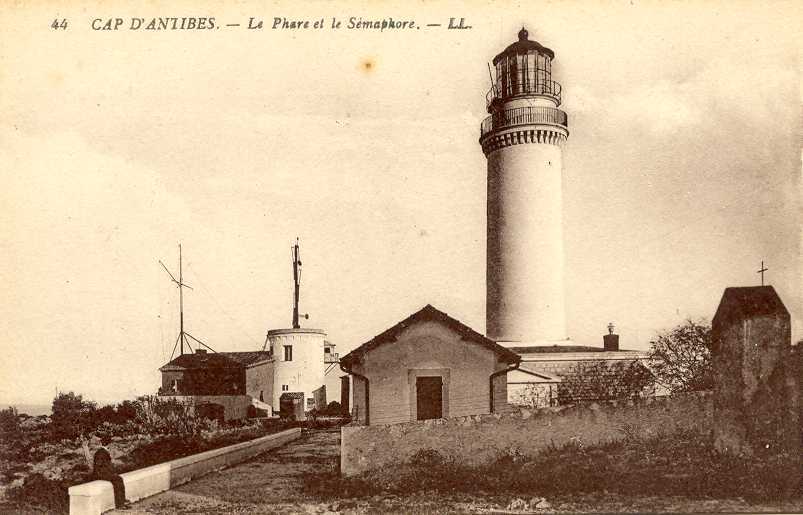
Then there is the oft neglected L'Îlette (Cap d'Antibes) feu built in 1910. Focal plane? Eighteen metres, displaying white, red or green aspects depending on direction, occulting three times every twelve seconds. The tower weighs in at fifteen metres tall, is both round and slender as well as being of white painted masonry finished off with black painted lantern above the gallery. Huelse has an historic postcard view of the original lighthouse.

I can't imagine I would feel at home in Antibes.
After Antibes the coast of vacation delights continues easterly via various holiday ports of call, such as Saint Laurent du Var, each centre usually exhibiting a feu or two on their marina moles to guide over confident yachtsmen into safety after hair-raising encounters with morons on jet skis out there on the turquoise Med. There is Nice airport to get round, but after that we are arriving in Nice, the most fashionable Fr. Riviera city of them all. A closed book to your author sadly. As mentioned above, the s&h has been here, and even managed to get locked into one of Nice's nicer parks for his pains. Here is his image of the lighthouse simply referred to as Nice.

The 1928 lighthouse, the fourth on the Nice breakwater, was heavily damaged during ww2; it was replaced by a wooden tower in 1945 and then by this lighthouse. Sadly Huelse does not have an historic postcard of the former lighthouse so we shall have to be satisfied with this post war replacement image. With kind permission etc.

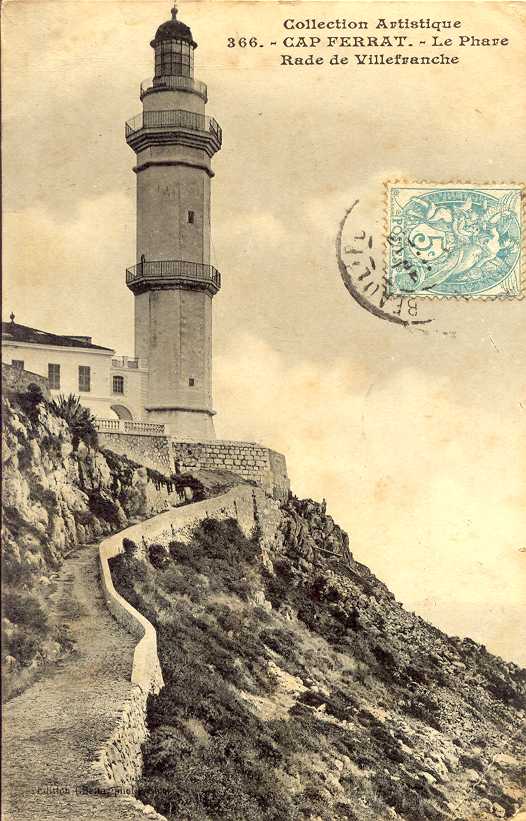
Cap Ferrat is across the bay from Nice, a very prominent cape projecting into the Mediterranean between Nice and Monaco. The lighthouse of the same name was constructed upon the cape in 1952 although the station it occupies was established as long ago as 1838. It boasts a focal plane of some 69 metres giving out a white flash every three seconds over a range of twenty-five nautical miles. The tower itself is a generous 32 metres, a strikingly modern designed octagonal stone tower with lantern and gallery, attached to a co-ordinated masonry keeper's house, all in unpainted white stone; the lantern is green painted with a white roof.
This is one of the oldest light stations of the Côte d'Azur, along with Cap Camarat and Antibes. It was established by the Kingdom of Sardinia, which controlled Nice until 1860. Huelse has a historic postcard view of the original lighthouse, which was yet another phare blown up by German troops in 1944. You'll find this is the last lighthouse proper, before reaching Monaco and then Italy, above the point of the cape, on the Avenue du Phare in Villefranche-sur-Mer. Not open to the public I gather. A pity. After all, it is a Monument Historique.
There are a few dribs and drabs of feux beyond Cap Ferrat. Monaco has nothing to trouble the scorer with; all these lights, all the way to the Italian border are very minor indeed (although Menton is worth a look at, an old tourelle that survived destruction in ww2, see The Lighthouse Directory for that feu); I shall not be entertaining them in this post, that's for sure.
So there you have it. Just two posts left to complete the Pharesighted album. It has been fun while it lasted. Now I suppose I'd better do something a bit less trivial. If you have been, thanks for following. Don't forget to log into 89 la corse and 90 acknowledgements. When I get round to doing them.
Thanks here to JBH for the illustrations above, and to The Lighthouse Directory, and Trabas in association with the Directory for the Phare de la Maure and L'Îlette pictures. Oops (again) … almost forgot. Thanks to Adam Melling-Smith for his well crafted photographic composition featuring the lighthouse at Nice. Very nice. He was clearly tutored by a master…