Since this post was first assembled the omission of the pilgrimage and ascent of this singular edifice, as mentioned below, has been most successfully addressed.
Rather than scrap this post altogether (so much good stuff there is, therein) may I additionally refer you to appendix seven: Cordouan? Well worth the trip, the outlay, and that's just to the appendix, the illustrative descriptor that appendix seven offers, to further inform and delight my most avid readership…
If you get the chance, ever, take the trip to Cordouan yourself…
THIS LIGHTHOUSE IS SACRED TO THE FRENCH.
Here is the oldest operational lighthouse in France, the origins of which date back to 1584, a statement of royal domaine in concert with church, which is why it has royal apartments and a chapel. I understand no official royalty has ever bothered to turn up. Hey! That was just a year before the school I went to (QEGS) started up after Elizabeth the First gave her gracious permission for a school in my home town! Yo!
But look here, I am not going to try and come the historian with you, there are loads of websites where you can find out more about this arguably most famous French phare. I shall only give you the basic facts. Please keep in mind that Mme Melling, the s-&-h and your correspondent had never done more than gape at this one from the shore; attempts to take the memorable snap-of-snaps have been thwarted by the lack of boat, helicopter, top-flight telephoto with suitable camera attached — and cooperative weather. Now all that has been put to rights: we've been and gone and done it, although the s-&-h was off to Portand Bill, so not with us…
Here is the oldest operational lighthouse in France, the origins of which date back to 1584, a statement of royal domaine in concert with church, which is why it has royal apartments and a chapel. I understand no official royalty has ever bothered to turn up. Hey! That was just a year before the school I went to (QEGS) started up after Elizabeth the First gave her gracious permission for a school in my home town! Yo!
But look here, I am not going to try and come the historian with you, there are loads of websites where you can find out more about this arguably most famous French phare. I shall only give you the basic facts. Please keep in mind that Mme Melling, the s-&-h and your correspondent had never done more than gape at this one from the shore; attempts to take the memorable snap-of-snaps have been thwarted by the lack of boat, helicopter, top-flight telephoto with suitable camera attached — and cooperative weather. Now all that has been put to rights: we've been and gone and done it, although the s-&-h was off to Portand Bill, so not with us…
Be in no doubt, this is a special lighthouse; beautiful, back to something like after much neglect, now having been addressed by a considerable restoration programme. Cordouan was where the first Fresnel optic was tried and found to be a massive improvement on what had gone before. This fact is as significant as the building itself in my humble opinion. That first optic can be inspected at the Phares et Balises museum on Île d'Ouessant. We've done that (inspected it) but I am not sure which of the optics I photographed there is that one. It'll teach me to be more attentive in future.
Cordouan is a working lighthouse so I expect we must forgive Phares et Balises for removing the occulting system (which we witnessed working each night when lodging in La Grande Côte back in 2002) for a more efficient but utterly uninspiring Halogen then LED flasher. I believe the range to be 22 nautical miles, for the white light, at least.
Cordouan shares with Nôtre Dame in Paris the distinction of being the first structures in France put up for Unesco World Heritage status. It has gained that status now (2021) although, what it takes to get the thumbs up on that and who gives it anyway, is not known to me. Maybe God? You can safely assume it has Monument Historique status as well, of course.
 Here is The Lighthouse Directory entry in précis:
Cordouan has a focal plane of approximately 60 metres or 197ft. It displays white, red, or green, depending on the direction of your approach, occulting three times every twelve seconds: one short, one medium, one long flash. The tower is 68 metres tall (223ft) overall, a lantern (of course) and no less than three galleries. It has a first order Fresnel Lens but the revolving aspect of that optic has been dispensed with I understand. Pah!
Cordouan is a working lighthouse so I expect we must forgive Phares et Balises for removing the occulting system (which we witnessed working each night when lodging in La Grande Côte back in 2002) for a more efficient but utterly uninspiring Halogen then LED flasher. I believe the range to be 22 nautical miles, for the white light, at least.
Cordouan shares with Nôtre Dame in Paris the distinction of being the first structures in France put up for Unesco World Heritage status. It has gained that status now (2021) although, what it takes to get the thumbs up on that and who gives it anyway, is not known to me. Maybe God? You can safely assume it has Monument Historique status as well, of course.

Cordouan has a focal plane of approximately 60 metres or 197ft. It displays white, red, or green, depending on the direction of your approach, occulting three times every twelve seconds: one short, one medium, one long flash. The tower is 68 metres tall (223ft) overall, a lantern (of course) and no less than three galleries. It has a first order Fresnel Lens but the revolving aspect of that optic has been dispensed with I understand. Pah!
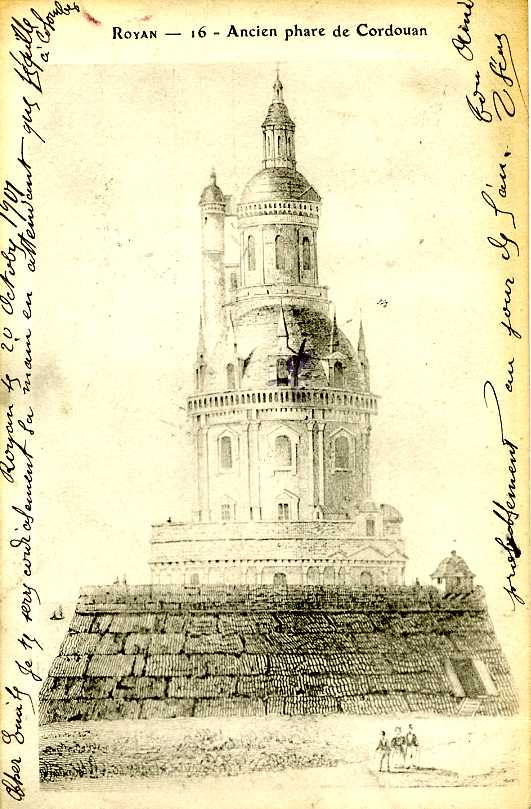
The obelisk is an unpainted light honey-and-grey limestone; the lantern and its gallery are a darker grey. The assembly includes a cylindrical three-storey base with two galleries, built in 1611, which was then surmounted by a tall conical tower, completed in 1788.
Cordouan marks the entrance to the Gironde, standing on a sandbar in the mouth of the estuary. According to legend, Charlemagne commanded that a light be shone here in the early ninth century. It's more likely that the English Prince Edward (The Black Prince), ruling southwestern France as the Duc d'Aquitaine, built a 16 metre stone tower in 1360 and engaged monks to keep a fire burning. So after all the fuss this proves the origins of Cordouan are sort of English!

In 1645 the wood-fired lantern was blown off by a storm and replaced by a new lantern which burnt whale oil. In 1727 a third lantern designed for charcoal was substituted. Parabolic reflectors of the Argand design were installed in 1782, but shortly thereafter the original superstructure was removed entirely and replaced with the conical tower that we see now. In 1823 Augustin-Jean Fresnel brought the first of his lenses to the tower, and here he perfected the lens designs that were soon in use around the world. The last Fresnel lens used in Cordouan was installed in 1854 during a restoration of the tower ordered by Napoleon III.
 The lighthouse was not electrified until 1948. In 1981, with the tact and sensitivity that state funded bodies are renowned for the world over, the Bureau des Phares et Balises announced plans to replace the historic tower with an offshore light-float. This led to a great uproar (national strikes I shouldn't wonder) and the formation of a preservation group. Now called the Association des Phares de Cordouan et de Grave, the Association maintains the museum devoted to the history of the phare at the Phare de Pointe-de-Grave, as you will know if you have already read my post concerning Pointe-de-Grave. Instead of abandoning the lighthouse, steps were taken to restore it. In 1987 a modern halogen lamp was installed (see left). Since the lamp's light could now be flashed, the rotating mechanism was retired — something I deplore. In 2005 a new restoration was completed. Further work has also gone on subsequently, concluding in 2012. I can confirm from our April 2026 inspection that this renovation has been completed most successfully, without totally obliterating the historic wear and tear that you'd expect to see in an edifice of this vintage.

Thanks are distributed to Jean Benôit Héron, whose renditions of Cordouan are available in a number of formats, and to Stéphane Bossis for his elevation of the phare seen in my empty car park montage above. The model-in-a-glass-case (of the original Louis de Foix construction)


Cordouan marks the entrance to the Gironde, standing on a sandbar in the mouth of the estuary. According to legend, Charlemagne commanded that a light be shone here in the early ninth century. It's more likely that the English Prince Edward (The Black Prince), ruling southwestern France as the Duc d'Aquitaine, built a 16 metre stone tower in 1360 and engaged monks to keep a fire burning. So after all the fuss this proves the origins of Cordouan are sort of English!

The lower surviving portion of the phare is the work of Louis de Foix, who spent twenty-seven years building and seemingly funding it, from 1584 to 1611. It nearly bankrupted him. This original structure was imperial in outlook first and phare second: an elaborate concoction that included a chapel and a royal apartment. Just what you need on a sand-bank in the Gironde. The model I show is the one in the museum on Ouessant, sorry for the reflections. Huelse has a drawing of this famous building which gives you another impression of the edifice.
 |
| Augustin Fresnel |

Cordouan is the last keepered lighthouse in France; Guardiens Cordouan occupy the building in the summer season, working on needed maintenance and (unfortunately) guiding visitors.
Where is it? Why, Cordouan is about seven kilometres west-north-west of the Pointe-de-Grave. Boats go from Pointe-de-Grave and/or Royan in the summer season, but be warned: wet feet are almost de rigeur. But not in our experience, dear me no. We were delivered right to the front door, my dears. I was a bit disappointed: I had hoped for a mooch on the sandbank that adjoins the paved causeway but the tide hadn't dropped that far. First boat arrival though. Never mind, we kept our feet dry. And furthermore, Mme Melling and self cut the inevitable historic presentation laid on in the entrance hall by a keeper chappie (we are well versed in the history of the site: no need to hear it recited and anyway in Fr, to my shame me non comprehendo, IBMS) so reached the lantern first (Madame leading the way, thus premiering the day's ascents; me huffing and puffing up the 301 steps in pretty short, following order, aussi) –– giving us the distinct advantage over the rest of the visitors, of entry and inspection of all the lighthouse's chambers without impediment. Amazing! And they are rather singular, those spaces. Why not visit appendix seven right now and marvel at the interiors captured therein? Go on, go on -– you know you want to.

Thanks are distributed to Jean Benôit Héron, whose renditions of Cordouan are available in a number of formats, and to Stéphane Bossis for his elevation of the phare seen in my empty car park montage above. The model-in-a-glass-case (of the original Louis de Foix construction)
was snapped by me and is in Les Phares et Balises Museum on Ouessant); while there is a very good current-tower model of Cordouan in the Pointe-de-Grave Museum.
But don't miss out! Visit appendix seven for more, much more!